Spore Creation Just Another Procedure

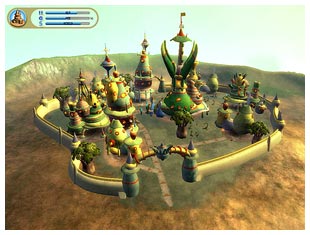
Spore screenshot

Last night I caught a blurb over on Blue’s News that the website for Will Wright’s Spore is now up and running (and kinda cute). Above is one of the cool screenshots from the game… and there’s another one on a previous entry of mine here.

Today Wired online has an interview with the Creator himself in which he even mentions Eames’ Powers of Ten. From the interview:

User-created content has two extraordinary benefits. No. 1 is that when somebody makes a piece of content, they are so much more emotionally attached to it. It doesn’t even matter if it’s good or bad. If they made it, it’s really cool, and they’re totally interested in what happens to it. No. 2, players love trading and sharing and spreading this stuff around and having it come to them, and building up their worlds.

This may be the future of online content. Did he say “parametrically”?

Advertising and Videogame Spectators

Simply put: advertisers are already planning to target their ads at videogame tournament spectators. From Yahoo News/Reuters:

Peter Moore, the Microsoft vice president in charge of advertising for the Xbox business, described a scenario where a virtual race hosted by a corporate sponsor, with thousands of gamers competing for a grand prize while their buddies and competitors watch online.

Read all about it here.

Pop Culture Consciousness

BusinessWeek online has another excellent article. This time on the emerging popularity of videogame music. For old school Quake fans, this will come as no surprise – Nine Inch Nails was doing game music years ago. And although more popular bands like Front Line Assembly get more attention for their game efforts, within gaming circles musicians like Kevin Riepl and Bill Brown have the attention of their fans as well.

What’s more interesting to me is how this relates to other game and virtual world content. There are popular figures within the gaming community unknown to the general public – texture artists, skinners, modelers, aso – who may some day garner the same kind of attention we know reserve for traditional artisans.

(edit – turns out Wired is carrying a similar article today)

Selling the Experience

I had this conversation again yesterday:

Friend: Can you imagine that? Someone paid like a $100 for this sword-thing and it’s not even real! It’s nothing. Make believe. It only exists in the game.
Me: You need to think about it differently.
Friend: But it doesn’t make any sense. They’re buying nothing!
Me: What do you buy when you get tickets to a baseball game? Or a concert?

The only thing I can figure is that the perception of reality blinds people to this obvious commonality: virtual products aren’t much different than most entertainment, whether it be going to the Indy 500 to watch people race cars in a circle or going to Disneyland to visit Space Mountain, none of it is stuff you can put in the car, take home, and place on your shelf.

People don’t play video games because they have to, they do it because it’s fun. It’s a luxury we enjoy in developed countries when our basic needs are met. It’s really just like going to a sporting event. And there is also a social element. Perhaps not as immersive as the real thing (having a beer spilled on you in the bleachers is pretty immersive), but which is more social: watching the television alone in your room or playing Counter-Strike online with your clan?

The point is that what we now think nothing of was unthinkable not so long ago (e.g. paying some guy millions of dollars to dribble a ball on a wooden floor); and what is unthinkable now will likely be common in the not too distant future. Let’s not forget, there was a time when being an Actor was an almost shameful profession (in some parts of the world, they still think paying people to act is laughable). Which leads me to this article over on Gizmag about a videogame tournament with a $1,000,000 prize. Maybe when you read the article, Mark Cuban’s comments on broadcasting these videogame tournaments at digitally-enabled movie theaters doesn’t sound so far-fetched.