Claytronics to Claymation and Back

Cletus Clay by Squashy Software

There’s been ever increasing news about “digital clay”; so much so it’s difficult to not trip over all the articles showing up online. WorldChanging explains the concept pretty well I think:

Claytronics research arose out of a combination of work on microscale computing devices and work on telepresence, so it’s not surprising that the researchers emphasize the utility of the claytronics system as a means of doing virtual meetings with apparent physical presence.

You might recall an earlier post of mine which touched on a related subject. It’s fascinating stuff and I’m looking forward to seeing the technology mature.

At the heart of this all afaik is Smart Dust, a technology that started showing up on my radar while surfing the web’s more off-the-beaten path sites like Nanotechnology Now, a good source for this kind of information (example). Anyone who watched Star Trek: The Next Generation back in 1989 probably had some idea about this potential technology just from watching the “nanites” episode. It was cool then and it’s just as cool now. And the merging of Smart Dust technology with telepresence is equally compelling.

But there’s so much news coming out I haven’t had time to properly digest it all… and so I’ve decided not to try right now. Instead I’ll just post some links and you can read them for yourself if you’re interested.

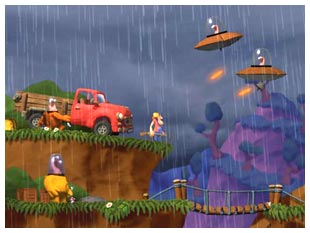
Why bother with this entry then? Well, mainly because a long time ago I used to make claymation movies and have always loved the look of it. And because some of the articles use claymation (which is really just stop motion animation using clay) as a way to explain the technology (now being dubbed “claytronics”), I wanted to use some crude subliminal techniques to draw your attention to a small indy game developer called Squashy Software, a one-man operation (I’m pretty sure) on the far end of the Long Tail. The above screenshot is from a forthcoming videogame called Cletus Clay (I love it). You can check out more screenshots and even give his other game, Platypus, a test drive. Heck, maybe even buy it (/crude subliminal endorsement).

Okay. Sorry about hijacking my own post. Here are some links:

PARC Research: Smart Matter Integrated Systems

Carnegie Mellon Univ: Claytronics – Synthetic Reality

Intel: Dynamic Physical Rendering

WorldChanging.com: Xerox PARC and Smart Matter

Post-Gazette.com: ‘Programmable matter’ one day could transform itself into all kinds of look-alikes

WorldChanging.com: Claytronics and the Pario World

(above image © Squashy Software)

When Objects Communicate

Vorwerk robot vacuum

I guess if a robot is going to vacuum a carpet, it should be able to talk to the carpet. And that’s basically what this puppy can do – talk to the carpet via embedded RFID chips (just wait until they use inks and dyes to weave it in). From the Discovery Channel news website:

Now the manufacturing company Vorwerk in Hamlin, Germany, has partnered with Infineon in Munich to develop an electronic carpet that wirelessly navigates a self-propelled robot over every square inch of a floor, and can even direct the machine to revisit sections it unintentionally missed.

I assume the next rev will have the carpet complaining about dirty spots and directing the robot to specific locations to do a more thorough job.

My favorite part of this news item though is when Burcu Akinci, the “expert” that apparently was in the office to answer the phone that day, makes this insightful statement: “If the whole room gets flooded, then I think the robot wouldn’t be able to navigate easily.” Classic.

(As an aside, the generic topic of object-to-object communication is especially interesting in that this capability is very much a “virtual space” feature. Barriers just keep dropping between the real and the virtual.)

(above image Copyright © Vorwerk)

Camphone Reality and Some Real Reality

While the ambitious ubergeeks are cobbling together head-mounted gear and lugging around home-made versions of a Xybernaut to play augmented reality games (like ARQuake which I’ve mentioned here before), the geektrepeneurs are surveying what’s available, bending it to their will, and coming up with interesting applications. And the latest example seems to be Camblaster, an interesting combination of cellphone camera technology and mobile gaming.

I think Jamais Cascio who posted this item over on WorldChanging.com where I found it, has already written what I’m thinking; so just go read his entry.

And for the industrial designers that read this blog, while you’re visiting the WorldChanging site, check out two other articles: this one on China and this one covering Bruce Sterling’s piece on technology.

Rosedale Interviewed

Via the Second Life forum I made my way to a Gamesblog interview of SL founder and CEO Philip Rosedale. From the interview:

In May 2005, the total amount traded in-world was USD$1.47 million. There were 1.3 million transactions between 19,500 unique users.

And to think this is really still in its infancy.

(edit: C|Net has latched onto this interview. you can read that entry here)

WoW Data

Terra Novan and mediated interaction researcher Nick Yee has posted on the Terra Nova website an announcement that World of Warcraft player data he and a few PARC researchers are collecting is now up for review and discussion on the PlayOn blog.

If you’re like me then World of Warcraft by itself doesn’t mean much other it being an online videogame. However, the information they’re extracting is pretty interesting. I may not know what’s happening at “level 40”, but comments like the following are easy to understand:

Plotting playing time against level by guild involvement shows several interesting trends. Playing time increases dramatically for guilded players right before level 40. Because of the new skills and mount granted at level 40, it makes sense that players may increase their playing time to achieve those goals. Perhaps being in a guild facilitates this because other guild members encourage and help players reach level 40 when they get close to it, thereby increasing playing time.

Sounds like the academic version of how I imagine Massive’s system operates. Interesting (and perhaps a little scary). But if I’m an advertiser, I know where I want my ads placed… right around whatever it is in level 40 that’s making players spend more time online (I’m imagining there’s some location-specific activity or item required for the player to level up).