The Ultimate ARG (or This Is Not A Videogame)

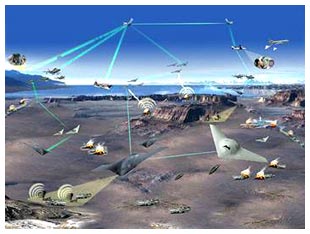
Image of the J-UCAS system in action

C|Net has a slideshow from the currently in-progress Paris Air Show. Notice that the first image in the slideshow shows a UCAV (Unmanned Combat Air Vehicle). Now look close and you should see a few of those flying drones/robots in the above conceptual image taken from the Joint Unmanned Combat Air System (J-UCAS) website. If you read the MIT Technology Review article I mentioned a couple months back in this post, the videogame aspect of all this is pretty obvious. Since that time however a couple more related bits have come along, including: news about swarming robots, word on an attempt to create a virtual brain, an announcement that the keel is being laid for a new kind of warship (the Littoral Combat Ship, a variation of which would presumably make an excellent platform for UCAVs), and plenty of discussion about military spending. There’s even another article similar to the MIT Tech Review piece – this time over on the Popular Science website (read “Trust Me – I’m a Robot” here) .

And all I wanted to see were some pretty pictures of the new Boeing jet I mentioned a couple days ago. Looks like pieces of this augmented reality stuff are everywhere; it’s just maybe not entirely obvious how it all fits together.
Where’s Your Head At?

There’s an interesting bit of reality mixing over on the PlaceSite Project – a kind of mash-up of wi-fi networking, Google maps, and … zombies. No, not “Night of the Living Dead” garden variety zombies. These are the I’m-too-busy-talking- on-my-cell-to- notice-the-light- turned-green variety.

Now I’ve seen the term used to describe this particular effect before, but not so … officially. “The Zombie Effect”. Sounds catchy, if not original. I hope that label makes its way out into the public. That might make it easier to explain the kind of interaction one can have with/within a virtual environment or videogame to those who engage in neither activity. Right now they just stare at you with these blank eyes when you try to explain this stuff. Jaw hanging; mouth slightly open. You know. They look a little like … well, hell … a zombie.

My god. They’re everywhere.

(via B. Sterling blog)

The Visceral Versus The Intellectual

New World Notes brings us this timely update to the ongoing efforts by some in Second Life to create a first person shooter (FPS) within the simulation. This isn’t a new story or a new idea, but I’m mentioning it now because it amplifies something I brought up in another post and some comments I made regarding that post on another blog. While academia focuses on the technical, I’m more interested in the social.

I’m going to pull out one line from the comment I wrote and leave it at that:

going from lines of code to 3D visuals will, i believe, have a profound effect on cyberspace not just because of the technology but because of how we react to that technology.

Recipe for a Metaverse: One Part Virtual Weapons

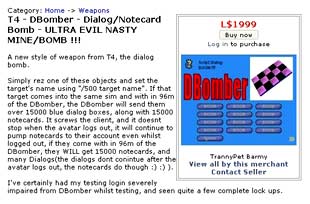
virtual weapon ad

I’ve hinted at this sort of thing in past posts, but thought I’d provide more this time; especially after seeing an online advertisement for this “griefing” tool.

This is an advertisement for a virtual weapon. It is designed to attack another person/avatar inside the Second Life virtual simulation. And it does this without – according to the creator – violating the Terms of Service by being… well… pretty creative. Read what it can do for yourself:

Simply rez one of these objects and set the target’s name using “/500 target name”. If that target comes into the same sim and with in 96m of the DBomber, the DBomber will send them over 15000 blue dialog boxes, along with 15000 notecards. It screws the client, and it doesnt stop when the avatar logs out, it will continue to pump notecards to their account even whilst logged out, if they come with in 96m of the DBomber, they WILL get 15000 notecards, and many Dialogs(the dialogs dont conintue after the avatar logs out, the notecards do though).

To provide some point of reference, this is equivalent to receiving 15000 spam emails and 15000 telemarketing phone calls all at the same time. Except the purpose isn’t to sell something, it’s to virtually assault someone – and this kind of assault often results in the target’s program (“client”) crashing. Additionally, as virtual worlds improve in sophistication, there’s no reason to believe computer worms and other malicious code won’t be included in the “sales package” of these kinds of virtual product. So there you have one ingredient of the virtual future. Hope you can handle the bitter stuff. Me? I’ve got this cool idea for a MIRVed virtual cruise missile with programmable payloads.

(edit: I’ve modified a comment to reflect a valid omission pointed out by someone commenting on this entry over on another blog. You can read more about my mistake, my correction, and the bigger point on which I’m hoping more people focus their attention here; or just read my comment copied below)