How Real Is Real?

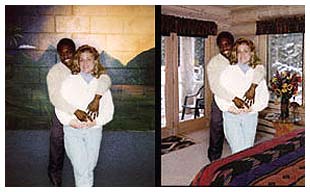
Wired is carrying an interesting article on a service that uses Photoshop to composite photos to create an illusion of freedom and happiness for prisoners and their loved ones; in effect, to create a kind of virtual reality from elements of reality. Check this comparison shot out:

prisonvirtuality

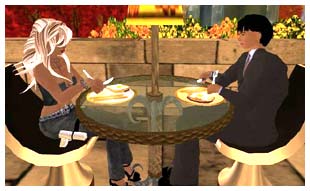
Now remember this post from shortly after I joined the Second Life virtual community? Back then I said “who’s to say what’s valid and what isn’t?” Look at the image below of two SL residents meeting virtually in cyberspace and explain to me how it’s arguably any less real than the composite above:

SL reality

I’d say there are a few people who have never been in an online virtual world who might prefer to have a say in what’s valid and wouldn’t put up an argument. This reminds me of the scene from “Blade Runner” where Roy asks Leon: “Did you get your precious photos?”

{Top image source: Friends Beyond the Wall ; Bottom image Copyright © 2005 Erelas Night}

The New Trust

I just caught a blog entry over on Nussbaum’s blog about AttentionTrust.org which struck a chord with some of the things I’ve had on my mind the past year or so. I’ll just post the comment (with links cleaned up) which I submitted to that blog:

Interesting. I’ll have to take a closer look at this and try to grok what this means. Over the {past} year or so, Reputation Systems (and reputation management) have been increasingly on my mind (example: this blog entry of mine regarding several aspects of it).

Furthermore, to me it’s another sign of convergence. On the one side we have RW-based attempts to manage virtual equity (reputation, “Attention”, whatever); on the other side we have VW-based attempts to bring RW legitimacy to bear on that same equity (example).

I have to thoroughly read what AttentionTrust is about; a first pass of their site isn’t fully registering with me (my synapses aren’t firing properly this morning; perhaps I need some coffee). It seems related to reputation… somehow. Nussbaum boils it down to “devices that will allow people to capture what is being recorded about them and how it is being used” and then managing that somehow. It’s the managing part I’m not getting yet, so I’ll go back to it later when I have more time to give it the attention it deserves (pun intended).

Pictures At 77

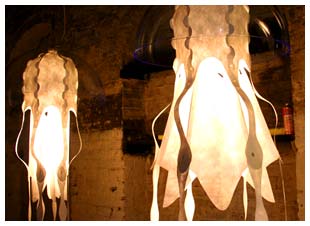
 John Wischhusen's swimming lamps

Core77 has posted an online gallery of photos from the current London Design Week. I’m partial to this John Wischhusen articulated lamp. Cool. The only problem is that the descriptive text under the images sucks. Many of the images don’t have text directly related to what you see – whole blocks of images can carry the same generic comment. Boo.

{Image Copyright © 2005 Core77, Inc.}

RW/VW Convergence Maps

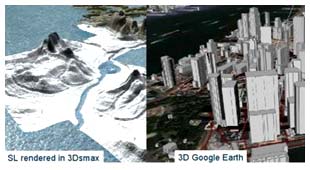
SL3D compared to Google3D

I see Jerry P (aka SNOOPYbrown Zamboni) has an entry up on the SL Future Salon (about bloody time, dude). He’s relaying news of Second Life resident Cadroe Murphy’s latest virtual world-to-real world endeavors.

In a nutshell (and I hope I get this correct – hopefully Cadroe will comment if I don’t), Cadroe has programmed a satellite to “fly” over the virtual landscape of Second Life and, meter by meter, collect height data (B&W images are often used to represent geographic data of this sort; peaks are white and valleys are black). This data is probably collected in an onboard code array (aka satellite’s hard drive), and then emailed out to him in real life when the satellite is finished with a sim (a segment of the landmass; there is one real life server at Linden Lab for every “sim” in SL). With each sim’s height data, he can combine them to reflect the sim layout in SL and then create a full 3D representation of the virtual world in a 3D app – such as 3DStudio Max or Maya or Terragen. And now he’s released his SpinMass Grid Chart application for people to play with and use for their own purposes – including I guess doing something like creating a GoogleMap hack. Neat.

What I’d like to see next from Cadroe is some 3D spatial carving. Data collection might not be all that bad, but the algorithm for combining it all might be tough (“carving” was used in the film “Minority Report” to create the consumer hologram f/x). But he’d have an advantage over Google: while they’re sending out trucks with lasers, he can make a ground-level satellite to record data horizontally at different angles. I’d say he has the advantage. Anyway, cool stuff all around.

{Image Copyright © 2005 Accelerating.org}

The Ideas That Get Out

A few days ago there was news (over on New Scientist no less) about a coaster that has embedded electronics that sense when a glass is empty and wirelessly notifies the barkeep. This struck me since I had that idea about 4 or 5 years ago and am surprised it’s now something new and innovative. Maybe it is. But there are practical reasons I discarded the idea – ranging from the obviousness of the idea (to me at least) to some of the patents I’d seen on the USPTO.gov site (yes I did some research). I have plenty of these kinds of things floating around in my head or doodled on scraps of paper I keep in a pile. Some of them extensions of this idea not discussed in any of the articles I’ve read, but which I’ve no doubt someone will now stumble upon.

What quite frankly bugs me is that someone could take an idea I had years ago and now claim a patent as if the idea first came to them before anyone else considered it. Yeah, I know, there’s a zillion people out there saying the same thing and I’m not alone. But there’s a difference now. I can broadcast that idea on the net so that some corporation can’t just come along and monopolize the idea. Just think if someone had broadbanded Amazon’s “One-click” patent, or Microsoft’s “Skin As Conducting Medium” patent.

So in the spirit of letting some ideas out, I just posted an idea on the Core77 forum. It has to do with the Nike/NBA2K6 videogame I mentioned earlier and updating content (which I discussed over on another blog). I’ll just quote the idea I posted directly:

This shouldn’t be hard to implement. A range of basic shoe models could be built into the game from day one and assigned a generic name. Each model has an associated UV map. When Nike or some other company has a new shoe design, they associate that with one of the generic models and generate a new UV map (or “skin”). This then gets streamed to the game. But in addition, that skin carries a “tag” – a code fragment. So say that when the real shoes are announced for sale in the real world, the virtual shoe code could be released so gamers can use that virtual model ingame.

For example:

Generic polygon model Code Main Fragment: 344566543
New shoe design skin: adfa433

Code to unlock the content: 344566543-adfa433

Next year’s shoe design using the same basic platform comes along and you get a new code frag: akea597

New product code to unlock updated content: 344566543-akea597

Of course someone probably has this one patented already, but regardless, it feels good to just say it. I’ve done this once before; the RadTag security device. Perhaps I’ll do this more often.