
I’ve been following a post by Cory Ondrejka over on Terra Nova (a monster thread) which might interest a few (perhaps a very few) of you. It’s basically a re-engagement of the “Text Worlds vs 3D Worlds” … *ahem* … discussion. It’s pretty low-level stuff which, to be honest, gives me a headache; but if you have an interest – and some extra aspirin – head on over for some gnarly virtual world theoretical banter.
Taking Notice of Anime – Good and Bad
If you’ve browsed through my links list, a few of them might seem out of place (and maybe a few are). One such link is “anime news“. I’ve referred to it only once before because, while interesting, I still consider anime’s impact on industrial design to be rather low-level. However, as manufacturing and design increasingly head to Asian suppliers in the same countries where Japanese animation has been off-shored, anime’s influence on product design could grow significantly; and I mean in the sense beyond the obvious Japanimation spin-off toys (eg Pokemon, Dragonball Z, Sailor Moon, etc). One example of how this kind of influence can be transferred is this computer mouse design created by Masamune Shiro, creator of the hugely popular Ghost in the Shell. As technology liberates designers from the tyranny of manufacturing constraints, this kind of crossover can only increase; more and more artists can move beyond images into tangible, manufacturable items.
That said, this brings me to today’s BusinessWeek online article “The Anime Biz“. From the article:
What’s more, the images that roll out of Japan’s studios inspire everything from Hollywood blockbusters to high fashion. Anime “has been hugely influential,” says John Lasseter, executive vice-president and creative chief at Pixar Animation Studios… He and other foreign media execs think the role of anime could expand much, much more. “It has the potential to be Japan’s next big export,” says Todd Miller, managing director for Asia at Sony Pictures Television.
Okay, so that was rather expected and reinforces some of my reasons for keeping an eye on that industry. But what was really interesting to me as a designer are the problems and difficulties the anime industry appears to be having. Some of the issues the article raises bring to mind recent conversations I’ve had with other industrial designers – discussions revolving around designers being allowed to move into the ranks of upper corporate management. I’ve always been hesitant on that issue and some of what this article points out is why I feel that way. This part is worth noting I think:
Just as problematic is a widespread lack of business savvy. While toymakers and TV broadcasters have made billions from marketing anime characters, most studios are run by artists who rose through the ranks of animators but have little experience in management.
It’s hard to argue with observations like those made in the article (some of the deals mentioned remind me of designers willing to work with no expectation of compensation – of any form – beyond gaining experience).
Sometimes I read things expecting one kind of story, and I get something more. This is one such article. If you’re in a creative profession I think you’ll also find it worth reading.
Claytronics to Claymation and Back
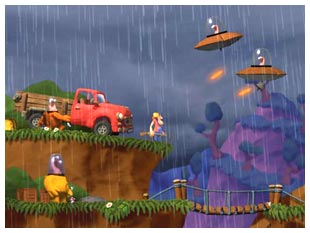
There’s been ever increasing news about “digital clay”; so much so it’s difficult to not trip over all the articles showing up online. WorldChanging explains the concept pretty well I think:
Claytronics research arose out of a combination of work on microscale computing devices and work on telepresence, so it’s not surprising that the researchers emphasize the utility of the claytronics system as a means of doing virtual meetings with apparent physical presence.
You might recall an earlier post of mine which touched on a related subject. It’s fascinating stuff and I’m looking forward to seeing the technology mature.
At the heart of this all afaik is Smart Dust, a technology that started showing up on my radar while surfing the web’s more off-the-beaten path sites like Nanotechnology Now, a good source for this kind of information (example). Anyone who watched Star Trek: The Next Generation back in 1989 probably had some idea about this potential technology just from watching the “nanites” episode. It was cool then and it’s just as cool now. And the merging of Smart Dust technology with telepresence is equally compelling.
But there’s so much news coming out I haven’t had time to properly digest it all… and so I’ve decided not to try right now. Instead I’ll just post some links and you can read them for yourself if you’re interested.
Why bother with this entry then? Well, mainly because a long time ago I used to make claymation movies and have always loved the look of it. And because some of the articles use claymation (which is really just stop motion animation using clay) as a way to explain the technology (now being dubbed “claytronics”), I wanted to use some crude subliminal techniques to draw your attention to a small indy game developer called Squashy Software, a one-man operation (I’m pretty sure) on the far end of the Long Tail. The above screenshot is from a forthcoming videogame called Cletus Clay (I love it). You can check out more screenshots and even give his other game, Platypus, a test drive. Heck, maybe even buy it (/crude subliminal endorsement).
Okay. Sorry about hijacking my own post. Here are some links:
PARC Research: Smart Matter Integrated Systems
Carnegie Mellon Univ: Claytronics – Synthetic Reality
Intel: Dynamic Physical Rendering
WorldChanging.com: Xerox PARC and Smart Matter
Post-Gazette.com: ‘Programmable matter’ one day could transform itself into all kinds of look-alikes
WorldChanging.com: Claytronics and the Pario World
(above image © Squashy Software)
When Objects Communicate
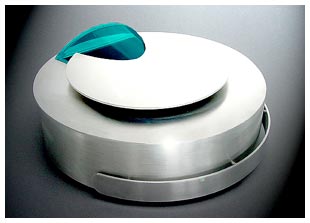
I guess if a robot is going to vacuum a carpet, it should be able to talk to the carpet. And that’s basically what this puppy can do – talk to the carpet via embedded RFID chips (just wait until they use inks and dyes to weave it in). From the Discovery Channel news website:
Now the manufacturing company Vorwerk in Hamlin, Germany, has partnered with Infineon in Munich to develop an electronic carpet that wirelessly navigates a self-propelled robot over every square inch of a floor, and can even direct the machine to revisit sections it unintentionally missed.
I assume the next rev will have the carpet complaining about dirty spots and directing the robot to specific locations to do a more thorough job.
My favorite part of this news item though is when Burcu Akinci, the “expert” that apparently was in the office to answer the phone that day, makes this insightful statement: “If the whole room gets flooded, then I think the robot wouldn’t be able to navigate easily.” Classic.
(As an aside, the generic topic of object-to-object communication is especially interesting in that this capability is very much a “virtual space” feature. Barriers just keep dropping between the real and the virtual.)
(above image Copyright © Vorwerk)
Camphone Reality and Some Real Reality
While the ambitious ubergeeks are cobbling together head-mounted gear and lugging around home-made versions of a Xybernaut to play augmented reality games (like ARQuake which I’ve mentioned here before), the geektrepeneurs are surveying what’s available, bending it to their will, and coming up with interesting applications. And the latest example seems to be Camblaster, an interesting combination of cellphone camera technology and mobile gaming.
I think Jamais Cascio who posted this item over on WorldChanging.com where I found it, has already written what I’m thinking; so just go read his entry.
And for the industrial designers that read this blog, while you’re visiting the WorldChanging site, check out two other articles: this one on China and this one covering Bruce Sterling’s piece on technology.