Stranger In A Strange Land

Jellybean Madison

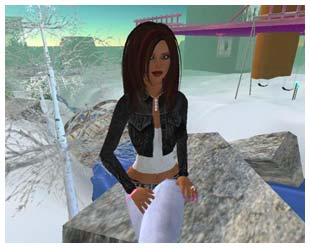
As mentioned in a prior post, I’ve been spending some time exploring Second Life’s virtual world. One expects that objects, graphics, animations, physics and the rest improve in this corner of cyberspace just like they do most everywhere else. That’s just technology, and videogames have certainly been showing off some amazing things lately. But what I’m finding interesting is how real people interact with – and through – this virtual world.

Take for example the above image, “sittin’ at the crick…”. For lack of a better description, this is a “photograph” snapped by an SL “resident”, Jellybean Madison. She (apparently) posted it online from within the SL simulation using a third party tool called Snapzilla. I’ll let them explain it:

Snapzilla [is a] new feature from SLUniverse that allows everyone in Second Life to share their snapshots with the world, directly through SL. Downloading snapshots to your hard drive and then uploading them is hardly spontaneous. With Snapzilla, you just click the Snapshot button in Second Life and choose Email Postcard and you are on your way to sharing your snapshots.

An image posted and given a caption? Emailed to others? Shared? Why? I don’t know exactly because I’m too new to the experience. But I have noticed that there are other, similar tools in beta which send images to sites like Flickr, possibly the best known and most popular image-hosting website on the net. So these snapshots will be seen by a large audience; many of whom have never been inside a virtual reality sim. Furthermore, in as much as all images online are really nothing more than colored pixels, these “photos” are as real to the strangers who view them as the “real” photos taken in meatspace using a 35mm. And when the graphics improve in years to come, who’s to say what’s valid and what isn’t?

But it doesn’t stop with photos. I was checking my email yesterday and discovered that an “in-world” message had been forwarded to my real world email. Lines blur. It’s one thing to know of this interactivity and another to experience it. And even more interesting are the number of independent projects coded by residents for doing things like tracking virtual world assets (which have real world value in many cases) outside the simulation. Now that sounds like the kind of thing Microsoft should build into their Xbox 2 feature set.
Getting X’d Out

Although not definitive, this piece over on Reuters makes it sound increasingly as if Microsoft’s Xbox 2 “Marketplace” will be more like a corporate-run mall instead of an open-air flea market. That would be a shame imo. Having spent the last couple of days exploring Second Life where players actually create content within the virtual world and conduct both virtual and real monetary transactions directly, I’m having a hard time imagining how a closed virtual economy can be a good thing. If game developers interface to MS’s Marketplace – and there’s a strong likelihood they will – they’ll need Content to continue flowing long after the game ships to consumers. And unless they intend to diversify into what, in the real world, is essentially an after-market “parts” market, I expect that they’ll start outsourcing this secondary activity to “modders”. And of course, everyone loves middlemen and the power they have to control (aka raise) prices. Same as it ever was…

Am I On A “Lost” Episode Or What?

I was reading an interesting interview with Natalie Jeremijenko and was, as a drawn-out consequence, thinking about the need for a rapid prototyping device that actually replicates itself. In this way, where it’s needed most – in under-developed regions – there is less likelihood of the technology being misappropriated by those with less-than-charitable intentions. Okay… in theory. And perhaps a little too pie-in-the-sky. But one quick hop over to New Scientist and I find a brand new article discussing this very same idea. And what’s more, Dr. Adrian Bowyer intends to make the “RepRap” open source. Awesome.

Now, couple this to some cool fuel cell technology whose by-product is potable water, and you’ve got yourself something of worth to the developing world it seems (as well to a few of us with additional ideas in mind).

Well this couldn’t have come at a better time. Earlier today I was hunting up new RP sites and reviewing old ones with little success. I did find a relatively new forum over at http://www.rapidprototyping.net and registered. And I even checked out Terry Wohler’s site (didn’t appear to have much new content since my last visit a few months back). Seems I have some additional googling to do though. No doubt people will be discussing the RepRap project. Just hope all my hits aren’t me out on the net going on and on about the article. Now what do I wish for next…

Influencers and This Designer

I’ve been spending alot of time utilizing Yahoo Music to feed my aural appetite. For what it’s worth I’m currently labeled a “Fanatic”, having rated a total of 2,408 items (songs, albums, artists) over about two months (the marketers/trend watchers/statisticians/etc at Yahoo doubtlessly love me). What I haven’t done is made “My Station” public. At first I thought,”Hey, why bother? I don’t use this email address they gave me (as part of my ISP account) so no one will be able to give me feedback anyway; and I won’t use it because getting email from strangers doesn’t seem particularly prudent when the net is incubating newer and nastier viruses by the nanosecond.” Now there’s some logic to this position. Except it’s a pointless point. If I don’t read the email people might send me, there’s obviously no danger. So why is My Station still private?

I suspect it has to do with a little feature Yahoo has which they call “Influencer”. Here’s Yahoo’s definition of “Influencer”:

An Influencer is another LAUNCHcast user that you select to influence the music played on your station. When you select an Influencer, songs he/she rates highly will be more likely to play on your station.

Now on the “My Station” webpage there’s this big squarish block labeled with a tab declaring “MY MUSIC INFLUENCE”. Inside it (in bold) are the declarations “I’m influenced by:” and “I influence:”. As a person who, by occupational definition, is an “Influencer”, this feature is a bit unnerving. No, I’m not a music critic; I design products. But my ego makes me reluctant to readily admit being influenced by just anyone (“Hey, I’m a designer!”) and even more hesitant to face the possibility that I influence no one (“Hey, where’s all the glowing email I should be getting?!”). This can’t be a healthy attitude. And although I read online comments about the products I’ve designed, I wonder how much I listen. Something I need to consider. If I react this way about music, how open am I to design criticism? Maybe not as much as I think.