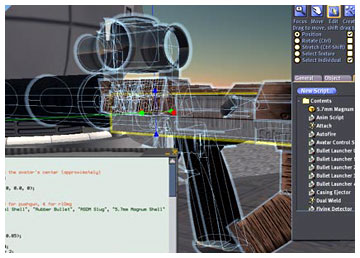
A Second Look at Second Life

screenshot from Second Life

Since this blog only went “live” yesterday (I’d disabled it’s pingback features until then) I was surprised to see someone outside my small circle of mostly disinterested acquaintances had stopped in to visit. Curious to know who, I paid Setpoint Originator a visit. It appears we have some things in common. More importantly, I noticed the two previous entries concerned Second Life, and so decided to pay a long overdue visit to its homepage and some other related sites. The one that really struck me was this blog entry over on Wonderland. The “Virtual Hallucinations” example reinforces my previous thoughts on Molyneux’s “The Room” experiment in that there are surprising (and perhaps startling) ways to use this technology, and makes me wonder if something similar couldn’t be coded into SL… perhaps the ability to create enclosed environments wherein more dramatic experimentation can take place. Just a thought. But of actually greater interest to me now are some of the virtual economic and social issues transpiring there. Worth a third look…tomorrow after a good night’s rest.

Economic Unrealities: XBox 2 Market Likely a Walled Garden

Polycount pointed me to this article over on GamesIndustry.biz that puts a damper on my enthusiasm regarding Xbox’s proposed Marketplace and Micro-payment features. While admittedly speculative, the possibility exists that Xbox 2 will harbor a closed economy for “modders”. That’s not to say it can’t and won’t be circumvented, but I’d personally hoped MS would embrace the possibilities of a more open virtual [game] world in a manner not too different from how Valve has handled Half-Life conversions and now supports new community efforts via Steam. Given some other pieces to the Gates Empire puzzle that I’ve collected over the years, and the assumption people in Redmond aren’t entirely unaware of how the Soviet Union’s stifling economic policies effectively lost them the Cold War, there’s still a possibility something more ambitious will be announced. So until we hear specifics, let’s leave it at that.

I Kinda Remember That Idea (on Instant Emergency Shelters)

Image from Wired magazine showing a shake 'n bake emergency shelter

Wired has a cool article, “Need a Building? Just Add Water”, on shake ‘n bake shelters. I especially like this idea because I volunteered something similar – though not as elegant – during a Rubbermaid R&D conference years ago. And this one is so much better since it’s intended for humanitarian aid and uses natural materials. Excellent example of what ID does best.

There’s Virtual Gold In Them Thar Virtual Hills

When the real world Gross National Product per capita of a virtual world ranks right behind Russia, there’s not much surprise in this story, “They play games for 10 hours – and earn £2.80 in a ‘virtual sweatshop'”, over on the Observer Guardian.

As they say, time is money. And this perhaps is one of the best examples I’ve seen. I imagine prospectors have staked their claims in poor, low-wage countries everywhere.

The Anti-Sony

C|Net is carrying an interesting article on Samsung. I seem to recall Samsung on a design hiring spree around 1997 – forming a partnership with a well-known design firm (whose name escapes me at the moment) and setting up studios to help them develop the kinds of products needed to…well…kick Sony’s ass. Looks like that effort, doubtlessly part of a much larger strategy, has worked.

This success does, however, pose a problem for me. The speculation is that Sony stumbled in part because they were attempting to protect their entertainment division. Even if someone dreamed up an iPod before Apple, when a company owns content, they’re naturally going to be hesitant to develop products which facilitate its theft. Before they got into the media business, they doubtlessly had little concern about the effects their Walkmans or VCR’s would have on the entertainment industry.

The problem now, for content creators, is that a lesson is being learned in corporate boardrooms everywhere; that lesson being: forget protecting content. For designers looking more and more at creating content as options to the declining job market in the West (as it moves to low-cost Asian countries), this does not bode well. And in the long run, it doesn’t bode well for the public who thinks nothing of stealing music and movies. That is unless Westerners are prepared to watch subtitled movies and listen to foreign-language pop songs.

I can just see redneck Bubba, dressed in his Indian-made Western clothes, listening to Filipino singers covering Hank Williams tunes on his Taiwanese radio driving his Japanese truck to his job at the Chinese buffet. Just hope he likes Tsingtao beer.